Dog Pregnancy Calculator: When She's Due, What to Expect, How Much to Feed Her
Just bred your dog and wondering when the puppies will arrive? Pop in the breeding date below and we'll show you her due date, where she is in the pregnancy today, and how much food she actually needs right now — in plain English, not vet-school jargon. Every number comes straight from the same vet-school and vet-manual sources your veterinarian uses, and you can click any answer to see the original quote.
People also call this a dog gestation calculator, a dog whelping calculator, or a dog due date calculator. Same idea — different names.
When is she due?
Best-guess due date: Thu, Mar 5, 2026 (about 63 days after she was bred)
She could be born between: Sat, Feb 28, 2026 and Sat, Mar 14, 2026 Dogs don't deliver on an exact day — anywhere in this window is normal.
Where she is right now: Day 35 · Week 5 · First 6 weeks
She's in the first part of her pregnancy. You won't see much change yet — keep feeding her the usual amount. Around day 21–30, your vet can confirm the pregnancy with an ultrasound.
Why an estimate, not an exact day: a dog's pregnancy averages about 63 days from when she ovulates, but it can swing anywhere from 58 to 72 days when you count from the breeding date — male dog sperm stays alive for several days, so she might not actually conceive until days after she was bred.
What to expect, week by week
A dog pregnancy lasts about 63days, or roughly nine weeks — usually split into three rough stages. Here's what's actually going on inside her, what you'll notice from the outside, and what to do.
First 6 weeks — she'll seem like her usual self
- Don't change her food amount yet. Most of the puppies' growth happens later, so for the first 6 weeks she only needs her usual amount of food. Overfeeding her now is one of the most common new-owner mistakes — it just puts weight on her, not the puppies.
- Do switch her over to puppy food now. As soon as you know she's pregnant, swap her food over to a complete-and-balanced puppy (“growth”) food. That's the vet-manual recommendation — not week 4, not week 6, as soon as you know. Puppy food has the extra protein, calcium, and DHA the puppies need from day one. Just don't switch her overnight — mix the new food into the old gradually over about a week (25% new on day 1, half-and-half by day 3, all new by day 7), so you don't upset her stomach. Our food transition calculator does the daily mix for you.
- Around day 21–30, the vet can confirm she's pregnant. That's when an ultrasound can see the puppies on screen, or a quick blood test can pick up the pregnancy hormone. Before that, even the vet can't tell for sure. Some signs you might see at home — a bigger appetite, slight morning sickness, a quieter mood — happen later and overlap with too many other things to be reliable on their own.
- Tiny milestones happening inside: by day 32 the puppies' eyelids start to form, by day 35 you'd see toes on an ultrasound, by day 40 they have little nails. You won't notice any of this from the outside, but it's happening.
Weeks 7–9 — the home stretch
- Now she needs more food. In the last three weeks she needs roughly 20–30% more food than usual. This is when the puppies really grow.
- Spread it across more meals. Her belly is filling up with puppies and there's less room for a big meal. Try smaller portions more often — three or four small meals instead of one or two big ones.
- Want to know how many puppies? From around day 45 onward, an X-ray at the vet can count them. That's the only way to know the number for sure before they arrive.
- She'll look noticeably pregnant. By the time she gives birth, she should weigh about 15–25% more than her usual weight. If you're worried she's gained too much or too little, that's a good thing to mention to your vet at the next visit.
After the puppies are born — she'll be much hungrier
- She might need 2 to 4 times her usual food. Nursing a litter is genuinely hard work. The more puppies, the more food — a single puppy is near the low end of that range, a big litter of eight or more sits near the high end.
- Just leave food out for her. Don't try to portion her now — let her eat whenever she wants. The vet manual recommends keeping puppy food available to her around the clock during nursing.
- If she's looking thin, the food may not be rich enough. If she's losing weight despite eating all she wants, the vet manual says to switch to a higher-fat puppy food. Worth a quick chat with your vet about which one.
- The most common slip-up: owners give her too much food while she's pregnant (when she's actually fine with her usual amount), and then not enough while she's nursing (when she really does need the extra). Save the food bump for after the puppies arrive.
What about the puppies? Around 4 weeks they'll start showing interest in solid food. Once they're weaned (usually 7–8 weeks), they need their own feeding plan. Puppy feeding calculator →
How much to feed her right now
Tell us where she is in the pregnancy and how much she weighs. We'll work out roughly how many calories and cups of puppy food she needs each day, using the same calorie formula vets use. (The cup count assumes a typical puppy food — for the exact number check the “kcal per cup” line on your bag.)
How much to feed her right now
Her usual amount (before pregnancy): about 893 calories a day
Right now: feed her about 1072–1340 calories a day
That's roughly: 2.7 – 3.8 cups of puppy food a dayA cup of puppy food usually has 350–400 calories — check the “kcal per cup” line on your bag for the exact number.
How many meals: 3–4 smaller meals
How will I know she's about to give birth?
The single most reliable sign is a temperature drop. Cornell's whelping guide gives a very specific window.
🌡️ If her temperature drops below 99°F, labor will likely start within about 24 hours
- A normal dog runs about 100–102.5°F.
- A day or so before labor starts, her temperature briefly drops below 99°F.
- The dip usually lasts about eight hours, so you'll need to take her temperature regularly (every few hours) toward the end to catch it.
Other signs she's getting close
- She starts “nesting”: shredding her bedding, digging at blankets, frantically rearranging her spot. She may also pace and pant more than usual.
- Clear or white discharge: a clear-to-white discharge can appear before birth. (Green or bloody discharge is different — call your vet.)
- Early labor can take a while. The first “stage” of labor — restlessness, panting, uterus contracting — usually starts 6 to 12 hours before the first puppy arrives, though it can stretch up to a day and a half. So when you notice the signs, you've usually got time.
- Time between puppies: once she starts delivering, each puppy usually arrives within about 30 minutes of the last one, and up to two hours between puppies is still considered normal. Longer than that — call your vet.
When can the vet confirm she's pregnant?
Four ways, each with the day range when it works. The earliest reliable confirmation is at about the three-week mark.
| Method | Day range | What it tells you | Source |
|---|---|---|---|
| Belly feel (palpation) | Day 20–28 | Vet gently feels the puppies through her belly. Yes/no answer. | |
| Ultrasound | Day 21–30 | Shows the puppies on screen, including their heartbeats. | |
| Blood test (relaxin) | Day 22–30 | Picks up a hormone she only produces when pregnant. Yes/no. | |
| X-ray | Day 45–55+ | Counts the exact number of puppies (their skeletons are visible). |
Printable dog whelping chart
Prefer a one-page lookup you can print or save? Here's the 63-day chart for the 1st and 15th of every month. For your dog's exact dates, the calculator at the top works any date and handles leap years.
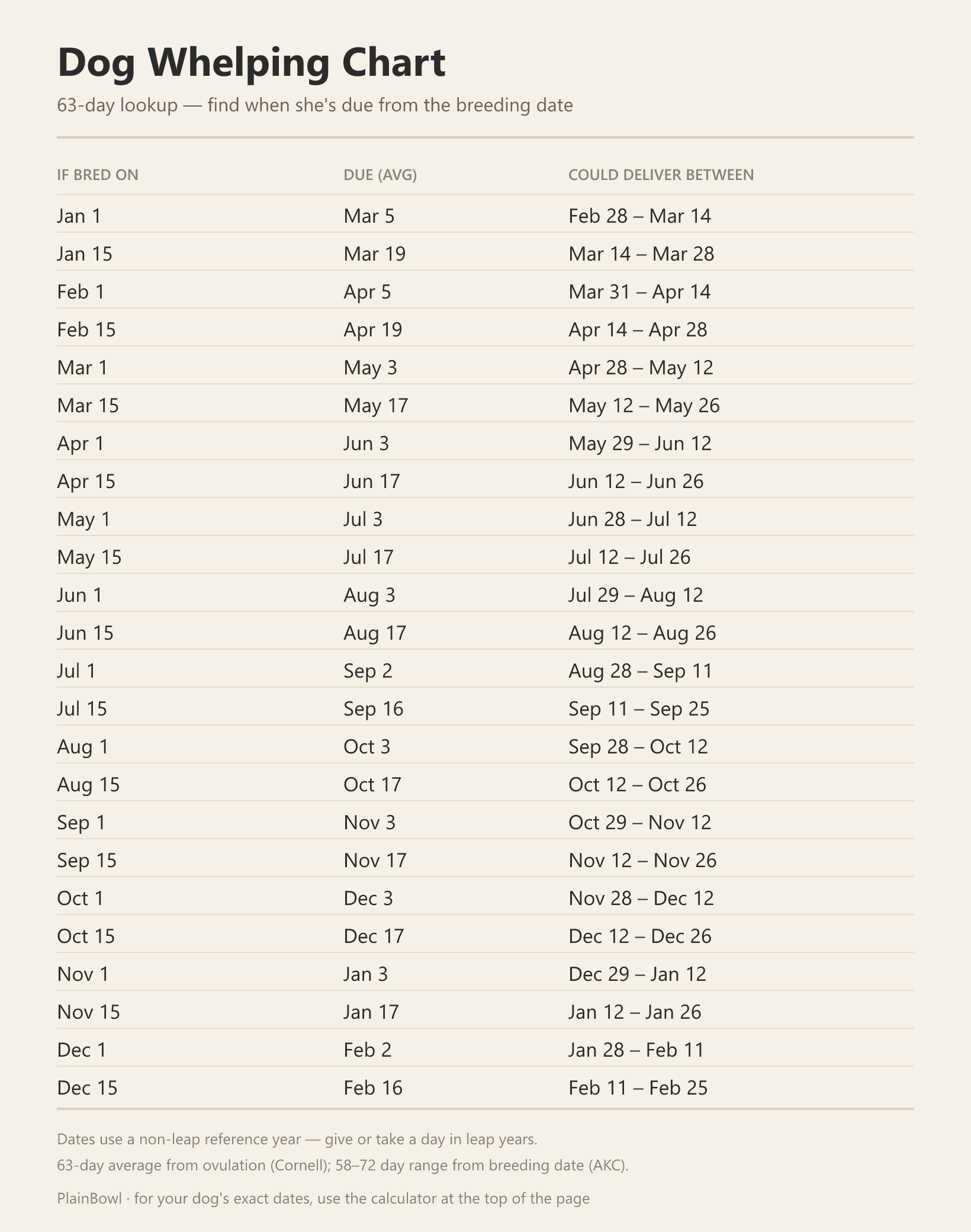
See the chart as a table
| If bred on | Due (avg) | Could deliver between |
|---|---|---|
| Jan 1 | Mar 5 | Feb 28 – Mar 14 |
| Jan 15 | Mar 19 | Mar 14 – Mar 28 |
| Feb 1 | Apr 5 | Mar 31 – Apr 14 |
| Feb 15 | Apr 19 | Apr 14 – Apr 28 |
| Mar 1 | May 3 | Apr 28 – May 12 |
| Mar 15 | May 17 | May 12 – May 26 |
| Apr 1 | Jun 3 | May 29 – Jun 12 |
| Apr 15 | Jun 17 | Jun 12 – Jun 26 |
| May 1 | Jul 3 | Jun 28 – Jul 12 |
| May 15 | Jul 17 | Jul 12 – Jul 26 |
| Jun 1 | Aug 3 | Jul 29 – Aug 12 |
| Jun 15 | Aug 17 | Aug 12 – Aug 26 |
| Jul 1 | Sep 2 | Aug 28 – Sep 11 |
| Jul 15 | Sep 16 | Sep 11 – Sep 25 |
| Aug 1 | Oct 3 | Sep 28 – Oct 12 |
| Aug 15 | Oct 17 | Oct 12 – Oct 26 |
| Sep 1 | Nov 3 | Oct 29 – Nov 12 |
| Sep 15 | Nov 17 | Nov 12 – Nov 26 |
| Oct 1 | Dec 3 | Nov 28 – Dec 12 |
| Oct 15 | Dec 17 | Dec 12 – Dec 26 |
| Nov 1 | Jan 3 | Dec 29 – Jan 12 |
| Nov 15 | Jan 17 | Jan 12 – Jan 26 |
| Dec 1 | Feb 2 | Jan 28 – Feb 11 |
| Dec 15 | Feb 16 | Feb 11 – Feb 25 |
Dates use a non-leap reference year — give or take a day in leap years. 63-day average from ovulation and 58–72 day range from the breeding date .
Quick rule of thumb: count 63 days from the breeding date and that's the best-guess due date. Plan for the wider 58–72 day window because male dog sperm stays alive for several days, so she might not actually conceive until days after she was bred.
Common questions
- How long are dogs pregnant?
- About 63 days — roughly nine weeks. But it's a range, not an exact number. Counted from the day she ovulated, you can expect her to deliver within a day or two of day 63. Counted from the breeding date, it's a wider window of 58 to 72 days, because male dog sperm stays alive for several days and she might not actually conceive until days after she was bred. Both ends are normal.
- How can I tell if she's pregnant?
- Honestly, the only reliable way is at the vet. Around day 21–30, an ultrasound can show the puppies on screen, or a quick blood test (for a hormone called relaxin) can give a yes/no. Around the same time, your vet can sometimes feel the puppies through her belly. After day 45 or so, an X-ray can even count them. Before three weeks, even your vet can't be sure — and the signs you might notice at home (slightly bigger appetite, a quieter mood, mild morning sickness) overlap with too many other things to be a real answer.
- When should I switch her to puppy food?
- As soon as you know she's pregnant. The vet manual is actually pretty firm about this — not week 4, not week 6, right away. Puppy food (sometimes labeled "growth" food) has more protein, calcium, and DHA than adult food, and the developing puppies benefit from all of it across the whole pregnancy, not just the last few weeks. To avoid an upset stomach, mix the new food into the old gradually over about a week — our food transition calculator (at /dog-food-transition-calculator) lays out the daily mix.
- How much should I feed her?
- For the first 6 weeks, the same amount you'd normally feed her — really. The puppies aren't big yet, and overfeeding now just puts weight on her. In the last 3 weeks, give her about 20–30% more food than usual, in smaller, more frequent meals because the puppies are taking up room in her belly. After the puppies are born and she's nursing, she might need 2 to 4 times her usual amount — let her eat freely. Use the calculator above for the exact cup amounts.
- How much extra food does she need while nursing?
- Quite a lot. Nursing a litter of puppies is genuinely hard work for her — depending on how many puppies she's feeding, she may need 2 to 4 times her usual food. A single puppy puts her near the low end of that range; a big litter of eight or more sits near the high end. Just leave puppy food out for her around the clock and let her eat whenever — don't try to portion her now.
- Is a gestation calculator the same as a whelping calculator?
- Yes — same idea, different name. "Gestation" is the medical word for pregnancy, and "whelping" is the word for giving birth. Both calculators estimate the same date: when she's likely to deliver. We use both names on this page because that's what people search for.
- Should I enter the breeding date or the ovulation date?
- If your vet checked her ovulation (usually with a progesterone test), that date will give you a tighter due-date window — about ±2 days around day 63. If you only know the breeding date, that's totally fine, just plan for a wider window of 58 to 72 days, because male dog sperm survives for several days and the actual conception could happen anywhere in that span.
- How will I know labor is about to start?
- The most reliable sign is her temperature. A normal dog runs about 100–102.5°F; about a day before labor, her temperature briefly drops below 99°F. The dip only lasts around eight hours, so toward the end you'll want to take her temperature every few hours to catch it. You'll also see her start nesting — shredding her bedding, frantically rearranging her spot — and panting more than usual.
When you should call the vet
This page covers normal, healthy pregnancy timing and feeding. Anything that looks medical — calcium supplements, difficult labor, she's not eating — that's really a phone call to your vet, not a website. Here's the short list of when to call.
- You're thinking about calcium pills. The right calcium for pregnant and nursing dogs is genuinely a medical decision — too much or too little both cause problems. Ask your vet, don't guess.
- She's pushing but no puppy is coming, or more than two hours go by between puppies. Call your vet immediately. Two hours is the line.
- Discharge that isn't clear or white. Green, brown, or heavy bloody discharge before birth is not a normal sign — call your vet.
- She won't eat for more than a day late in pregnancy. A short loss of appetite right before labor is normal. A longer refusal isn't — give your vet a call.
- She's losing weight while nursing, even on lots of food. The vet manual's first answer is to try a richer puppy food, but if that doesn't turn it around, that's a vet conversation.