Chihuahua Feeding Chart: How Much to Feed by Age & Weight
A healthy adult Chihuahua (3–7 lb) needs only about 140–270 calories a day — less than a cup of dry food, split into two small meals. Because they're so tiny, a careless treat or two can tip a Chihuahua into overweight, so measuring matters more than for almost any other breed.
Very young Chihuahua puppies are a special case: under about 4 months, toy-breed pups are prone to low blood sugar, so the priority is small amounts offered often — even keeping food available — rather than a strict once- or twice-a-day portion. The chart below gives weight-based starting points; the calculator tailors them to your dog.
Last updated 2026-05-28 · Every number links to its source.
💪 Chihuahua Adult Size & Growth
See raw data
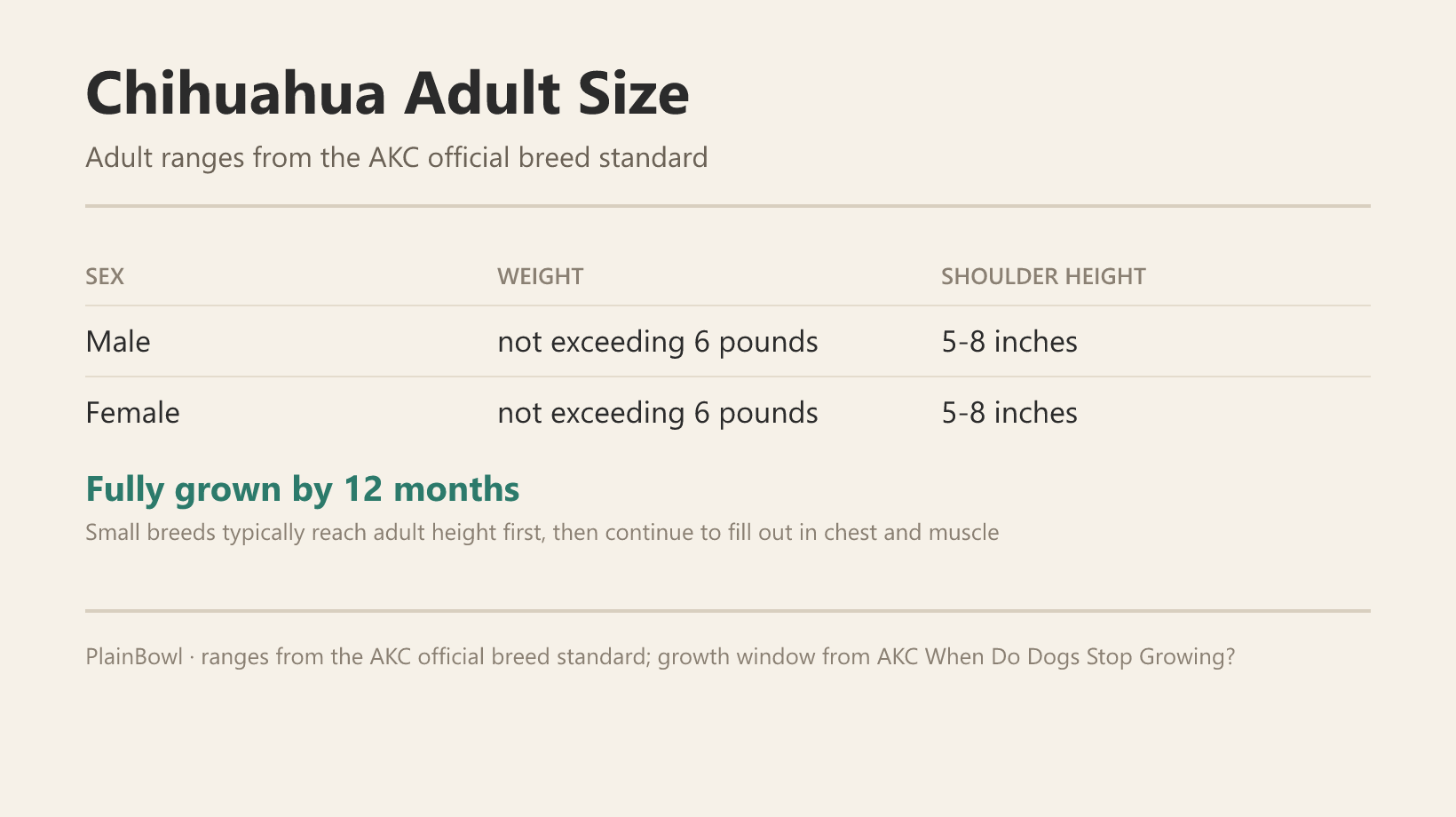
| Sex | Weight | Shoulder height |
|---|---|---|
| Male | not exceeding 6 pounds | 5-8 inches |
| Female | not exceeding 6 pounds | 5-8 inches |
Fully grown by 12 months (Small breeds typically reach adult height first, then fill out in chest and muscle).
Per AKC's Puppy Growth Chart, Small breeds reach about 75% of their adult weight by 6 months, 90% by 9 months, 100% by 12 months, 100% by 15 months, and 100% by 18 months.
Source: AKC Chihuahua official breed standard; AKC When Do Dogs Stop Growing? — every number verified verbatim.
Daily Feeding Amounts by Weight & Age
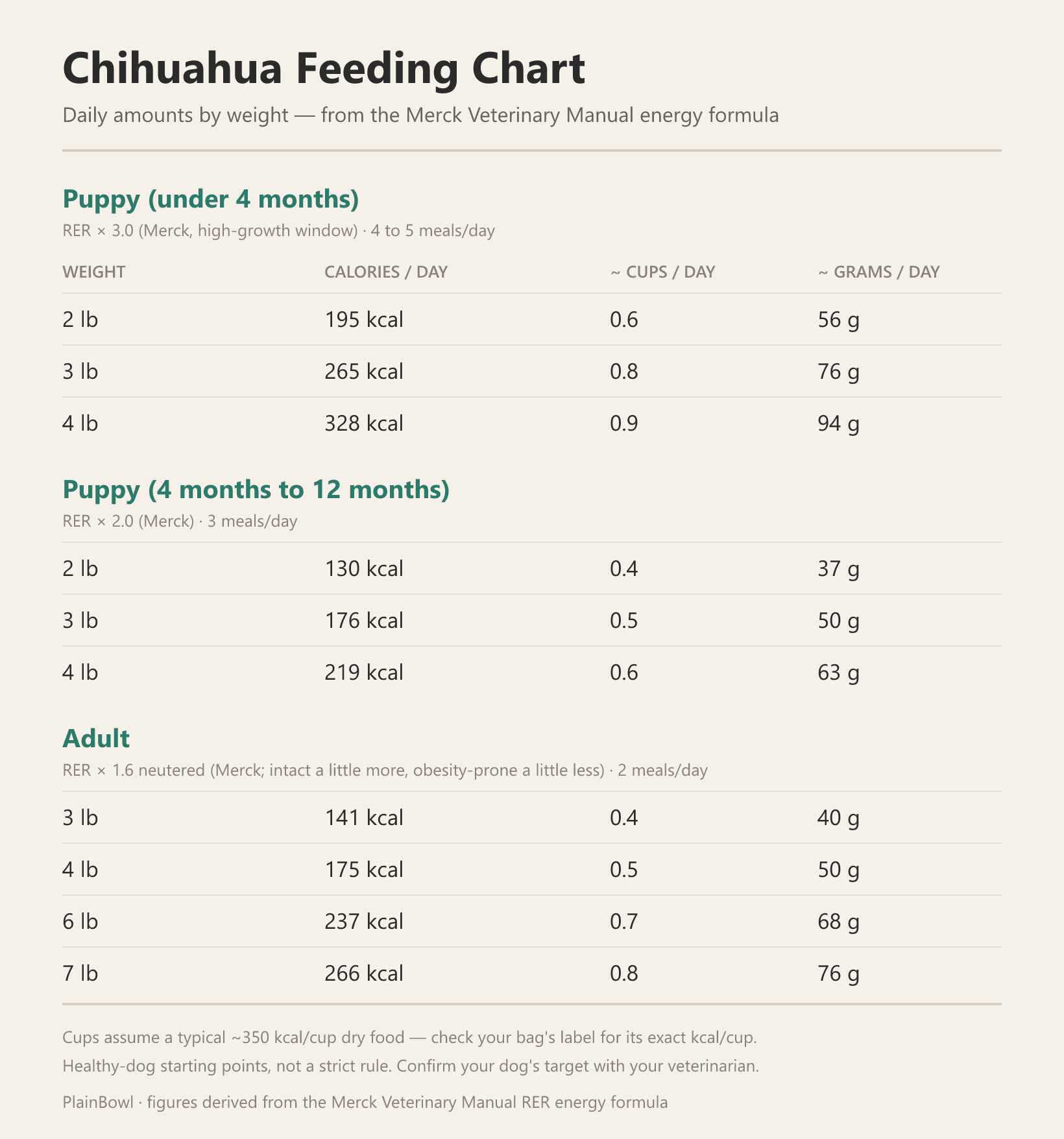
Find your dog's current weight in the chart for an estimated daily amount. Calories come from the Merck Vet Manual energy formula; cups assume a typical ~350 kcal/cup dry food, so check your bag's label for its exact kcal/cup.
 ⬇ Save chart as image
See the exact numbers as a table
Puppy (under 4 months) — 4 to 5 meals/day
RER × 3.0 (Merck, high-growth window)
| Weight | Daily calories | ~ Cups/day | ~ Grams/day |
|---|---|---|---|
| 2 lb | 195 kcal | 0.6 | 56 g |
| 3 lb | 265 kcal | 0.8 | 76 g |
| 4 lb | 328 kcal | 0.9 | 94 g |
Puppy (4 months to 12 months) — 3 meals/day
RER × 2.0 (Merck)
| Weight | Daily calories | ~ Cups/day | ~ Grams/day |
|---|---|---|---|
| 2 lb | 130 kcal | 0.4 | 37 g |
| 3 lb | 176 kcal | 0.5 | 50 g |
| 4 lb | 219 kcal | 0.6 | 63 g |
Adult — 2 meals/day
RER × 1.6 neutered (Merck; intact a little more, obesity-prone a little less)
| Weight | Daily calories | ~ Cups/day | ~ Grams/day |
|---|---|---|---|
| 3 lb | 141 kcal | 0.4 | 40 g |
| 4 lb | 175 kcal | 0.5 | 50 g |
| 6 lb | 237 kcal | 0.7 | 68 g |
| 7 lb | 266 kcal | 0.8 | 76 g |
These are healthy-dog starting points, not a strict rule — body condition and activity vary. Confirm your dog's target with your veterinarian. For your exact dog, use the calculator below.
Is my puppy a healthy weight for its age?
Rather than one “correct” weight, vets track puppies against evidence-based growth standards that run from 12 weeks to 2 years.
Those standards are grouped by a dog's adult body size (up to 40 kg), not by individual breed.
We don't publish a per-age “your puppy should weigh X” figure — that belongs on a vet's growth chart, weighed over time. What we give you instead is the daily caloriesfor your dog's actual weight today (the chart above and the calculator below), every number cited.
Adjust this plan for your own dog
The plan below is for a typical Chihuahua. Change the details to match yours.
The plan for a typical Chihuahua
🐕 Here's the plan for your Chihuahua
Healthy puppy (4 months+) · 4 months old · 2 lb
130 cal/day · ~0.4 cups · 4 meals/day
🍽 HOW MUCH YOUR CHIHUAHUA PUPPY SHOULD EAT
Your little one is growing fast — and that takes fuel. About 130 calories a day will keep your chihuahua on a healthy track.
Puppies have small stomachs and growing bodies that want food often. As your dog grows, you'll feed less often:
- • Under 4 months: 4 to 5 meals a day
- • 4 to 7 months: 4 meals a day ← your puppy now
- • 7 to 9 months: 3 meals a day
- • 9 to 12 months: 3 meals a day
- • 12+ months: 2 meals a day
Just look up your puppy's age in months and pick the row that matches.
💧 Water~2 oz/day▼
A good rule of thumb: a weaned puppy needs about ½ to 1 ounce of water per pound of body weight each day. The numbers below use the higher end as a safe target — most dogs settle in somewhere in this range.
Keep the bowl filled with fresh water.
🍬 Treatsup to 13 cal/day▼
Treats are great for training and bonding — but they should be the bonus, not the main course.
- • 90% of daily calories from real dog food
- • 10% from treats, chews, table scraps — anything extra
🛒 How to choose dog food▼
Walking into the pet store can be overwhelming. But you only need to check the back or side of the dog food bag for these things:
- ☐ The bag has an AAFCO Nutritional Adequacy Statement that mentions “growth”Look for a full sentence on the back or side of the bag containing both “AAFCO” and “growth”. Typical wording is one of two formats:
- “[Brand] is formulated to meet the nutritional levels established by the AAFCO Dog Food Nutrient Profiles for growth.”
- “Animal feeding tests using AAFCO procedures substantiate that [Brand] provides complete and balanced nutrition for growth.”
- ☐ “Calories per cup” is printed on the bagUsually in the feeding guide section. You need this number to know exactly how much to scoop for your dog.
🚫 FOODS TO KEEP AWAY FROM YOUR CHIHUAHUA
Some everyday human foods are dangerous — even tiny amounts can cause serious harm. Keep these well out of reach:
Never feed: chocolate, xylitol (sugar-free gum / candy / some peanut butters), grapes, raisins, onions, garlic, macadamia nuts, alcohol, caffeine, avocado.
⚠️ Xylitolis a sweetener that's safe for humans but can be deadly to dogs. If your dog ingests anything containing xylitol, call your vet right away.
- Free-feeding (leaving food out all day). It sounds convenient but makes portion control and weight monitoring much harder.
- Switching food suddenly. Transition over 7-10 days — mix the new food with the old in growing proportions to avoid an upset stomach.
- Switching to adult food too early. Puppy formulas are higher in protein than adult formulas — tuned for the demands of growth. When to actually switch? Small breeds (under 20 lb) at 8-12 months; medium breeds (20-50 lb) around 12 months; large breeds (50+ lb) at 12-15 months; giant breeds at 18-24 months.
💡 About Chihuahuas▼
These aren't about feeding amounts or food choices — they're the breed-background facts every Chihuahua owner is better off knowing.
- •Chihuahuas are prone to obesity, so portion control matters — at their tiny size, even small snacks are a big share of the day's calories.
📚 WHERE WE GOT ALL THIS
Every number and recommendation above comes from one of these sources. Tap any (▼) citation throughout the page to see the original wording. Full source documents are linked below.
- MERCK — Merck Veterinary Manual ↗The Merck Veterinary Manual (published as MSD Veterinary Manual outside the U.S. and Canada) is a free, comprehensive veterinary reference used by veterinarians, students, and pet owners worldwide. Its nutrition chapters are authored by named board-certified veterinary nutritionists.
- AAFCO — Association of American Feed Control Officials ↗AAFCO is a non-profit organization of U.S. state and federal feed-control officials that develops model regulations and nutrient profiles for pet food. Every dog food sold in the U.S. must meet AAFCO's standards to be marketed as 'complete and balanced'.
- AKC — American Kennel Club ↗The AKC is the largest U.S. registry of purebred dogs and a widely-cited authority on general dog care, breed information, and owner education. Its Chief Veterinary Officer and expert advice column publish nutrition guidance for everyday dog owners.
- FDA — U.S. Food and Drug Administration ↗The FDA is the U.S. federal agency that regulates food and drug safety, including pet food. Its Center for Veterinary Medicine publishes safety alerts about ingredients and household items toxic to pets.
- PMC — PubMed Central (NIH) ↗PubMed Central is a free archive of peer-reviewed biomedical and life-sciences research curated by the U.S. National Library of Medicine (NIH). Papers cited here are open-access primary sources.
Last verified: 2026-05-23
❤️ A friendly reminder: this is general guidance, not a custom plan for your dog.
The plan above reflects what the Merck Veterinary Manual, AAFCO, AKC, and the FDA publish for dogs matching your Chihuahua's breed, age, weight, and life stage. But every dog is different — habits, digestion, and individual quirks aren't in our data.
If something seems off, or you just want a second opinion, your vet is the right call. We've put together some talking points below to make that conversation easier ↓
🩺 QUESTIONS TO BRING TO YOUR VET
Save or print this list and bring it to your next visit.
- ❓ “What body condition score is my Chihuahua at now, and what's the ideal?”Why ask: The 1-9 body condition score is the standard vets use to tell if your dog is at a healthy weight.
- ❓ “When should we transition from puppy to adult food?”Why ask: Most small/medium breeds transition at 9-12 months — your vet can confirm based on your dog's growth.
- ❓ “Are there breed-specific screenings or watches for Chihuahuas at this age?”Why ask: Chihuahuas have known breed traits worth monitoring — your vet may suggest preventive screening based on age and lineage.
Chihuahua feeding — common questions
- How much should I feed an adult Chihuahua?
- A healthy adult Chihuahua (about 3–7 lb) needs roughly 140–270 calories a day — less than a cup of dry food, split into two small meals. The exact cups depend on your food's kcal per cup (check the bag); see the adult row matching your dog's weight.
- How often should a Chihuahua eat?
- Adult Chihuahuas do well on two small meals a day. Puppies need feeding more often, and very young toy puppies (under about 4 months) should get small amounts frequently — or have food available — to help prevent low blood sugar.
- When should a Chihuahua switch from puppy to adult food?
- Small, toy breeds like the Chihuahua can transition earlier than large dogs — generally between about 8 and 12 months. Your vet can confirm the timing based on your dog's growth.
- Why does my Chihuahua eat so little?
- Chihuahuas are one of the smallest breeds, so their whole daily ration is small — often well under a cup. At that size, a single biscuit can be a big share of the day's calories, which is why counting treats matters.
- Can I leave food out for my Chihuahua all day?
- For very young toy puppies, keeping food available helps prevent low blood sugar. For adults, scheduled small meals make weight easier to control than free-feeding — Chihuahuas put on weight easily.
- How do I tell if my Chihuahua is overweight?
- A general body-condition check: you should be able to feel the ribs without pressing through fat, and see a slight waist. If you can't feel the ribs, cut back portions and confirm a healthy target with your vet.
- When will my Chihuahua stop growing?
- Per AKC's Puppy Growth Chart, small breeds like the Chihuahua reach about 90% of their adult size by 9 months and full adult size by about 12 months. Chihuahuas typically finish growing earlier than larger breeds — most are at adult height and weight by their first birthday.
- What is the average adult weight of a Chihuahua?
- AKC's Chihuahua Breed Standard sets adult weight at not exceeding 6 pounds.
Helpful guides
Other breeds
- Labrador Retriever feeding chart →
- Doberman Pinscher feeding chart →
- Great Dane feeding chart →
- Shih Tzu feeding chart →
- German Shepherd feeding chart →
- French Bulldog feeding chart →
- Corgi feeding chart →
- Golden Retriever feeding chart →
- Dachshund feeding chart →
- Beagle feeding chart →
- Yorkshire Terrier feeding chart →
- Boxer feeding chart →
- Rottweiler feeding chart →
- English Bulldog feeding chart →
- Pomeranian feeding chart →
- Australian Shepherd feeding chart →
- Miniature Schnauzer feeding chart →
- Mastiff feeding chart →
- St. Bernard feeding chart →
- Pug feeding chart →
- Bernese Mountain Dog feeding chart →
- Border Collie feeding chart →
- Cocker Spaniel feeding chart →
- Boston Terrier feeding chart →
- Cavalier King Charles Spaniel feeding chart →
- Maltese feeding chart →
- Havanese feeding chart →
- Newfoundland feeding chart →
- Siberian Husky feeding chart →
- Cane Corso feeding chart →
- Toy Poodle feeding chart →
- American Staffordshire Terrier feeding chart →
- Great Pyrenees feeding chart →
- Standard Poodle feeding chart →
- Bichon Frise feeding chart →
- Bull Terrier feeding chart →
- Basset Hound feeding chart →
- Weimaraner feeding chart →
- Miniature Poodle feeding chart →
- Bullmastiff feeding chart →
- Standard Schnauzer feeding chart →
- English Springer Spaniel feeding chart →
- Australian Cattle Dog feeding chart →
- Jack Russell Terrier feeding chart →
- Shiba Inu feeding chart →
- Westie feeding chart →
- Vizsla feeding chart →
- Staffordshire Bull Terrier feeding chart →