Can Dogs Eat Pork?
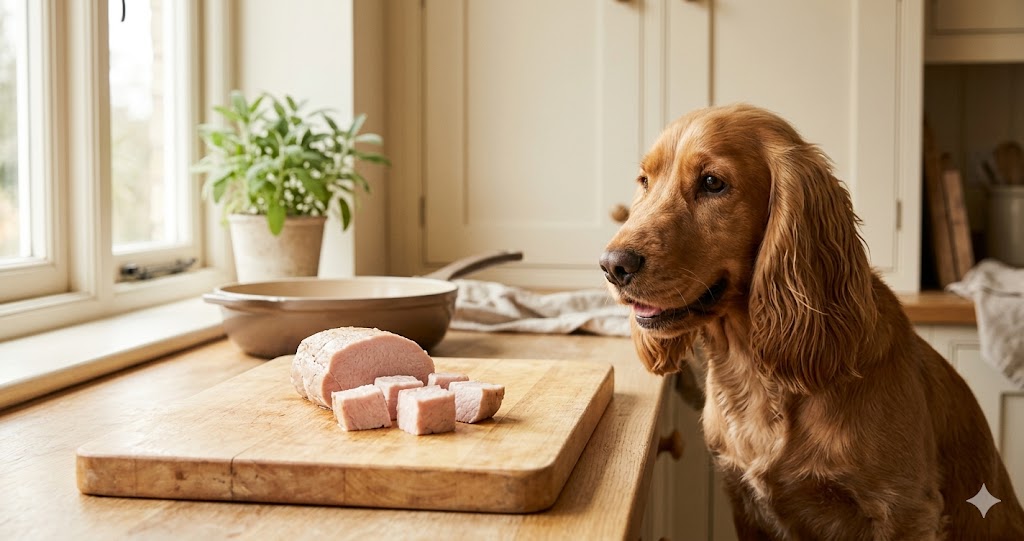
Yes — plain, cooked, lean pork is safe for dogs in moderation. The hard rules: NEVER raw pork (Trichinella parasites), no pork bones (cooked bones splinter), and no bacon, ham, sausage, or seasoned pork (salt, nitrates, and toxic spices like garlic and onion).
How much pork can my dog eat?
A 30-lb adult dog needs about 794 kcal/day, so treats should stay under 79 kcal. That's up to about 1 ounce of cooked pork a day as a treat.
A treat limit (10% of daily calories), not a target — assumes an adult dog. Puppies and special diets: use the full calculator.
Pork is a treat or food topper, not a meal replacement — keep it within the 10% treat allowance the calculator shows, and the first time, start with a small piece to see how your dog handles it.
Is pork good for dogs?
Pork is a complete protein — it carries all the essential amino acids dogs need, plus B-vitamins (B6 and B12), potassium, and zinc. The catch is fat: some cuts (pork shoulder, rib chops, pork belly) are high in fat that dogs struggle to digest, so stick to lean cuts like loin or tenderloin.
How to serve pork
- Cook it fully — no pink in the middle. Raw or undercooked pork can carry the Trichinella parasite, which is a real risk for dogs and humans alike.
- Serve it plain — no salt, no oil, no marinade, and absolutely no garlic, onion, or spice rubs.
- Trim the visible fat and stick to lean cuts — pork loin or tenderloin, not shoulder, rib chops, or pork belly.
- Cool it, cut into bite-size pieces, and start with a small amount the first time.
What to avoid
- NEVER raw or undercooked pork — it can carry Trichinella spiralis, a parasite that causes vomiting, diarrhea, and worse in dogs and people alike.
- No pork bones — cooked pork bones dry out, splinter, and can cut the mouth, throat, or gut. Raw pork bones still carry parasite risk.
- No bacon, ham, sausage, hot dogs, or other processed pork — they're loaded with salt and additives that can upset a dog's stomach or worse.
- No seasoned, marinated, or spice-rubbed pork — many rubs contain garlic and onion powder, which are toxic to dogs.
- Skip high-fat cuts like pork belly, pork shoulder, and rib chops — the fat is hard for dogs to digest and can trigger pancreatitis.
💡 What next?
Common questions
- Can dogs eat raw pork?
- No — raw or undercooked pork can carry Trichinella spiralis, a parasite that causes vomiting, diarrhea, abdominal pain, appetite loss, and weight loss. AKC and PetMD both say pork must be fully cooked before you give it to your dog.
- Can dogs eat bacon?
- No — bacon is too fatty and too salty for dogs. AKC describes it as 'incredibly rich and fatty… with a high salt content, which can prove to be too much for a dog's stomach.' Even a small piece can upset some dogs; over time it can contribute to pancreatitis.
- Can dogs eat pork bones?
- No — cooked pork bones dry out and splinter easily, and PetMD warns they can puncture the mouth or digestive tract. Raw pork bones carry their own parasite risk. Skip bones entirely and feed only boneless cooked pork.
- Can dogs eat pork chops?
- Yes — plain, fully cooked, boneless pork chops with the fat trimmed are fine in moderation. Skip the bone, skip the marinade, and keep it within the 10% treat allowance the calculator above shows.
- Can dogs eat ham?
- It's best avoided. Ham is a processed, cured pork product — it's loaded with sodium and often nitrates. PetMD notes processed pork products 'typically contain lots of salt, in addition to other seasonings and flavorings.' Plain cooked pork loin is the safer choice.
- Can puppies eat pork?
- Plain cooked, boneless, unseasoned pork in tiny amounts is generally OK for puppies, but their main calories should come from a complete-and-balanced puppy food. Skip bacon, ham, bones, and anything seasoned — and start with a very small piece to make sure it sits well.
- How much pork can my dog eat?
- PetMD's rule: 'Treats should be fed in moderation, making up no more than 10% of the total calories of your dog's daily diet.' The calculator above turns that into ounces for your dog's weight — for most dogs that's an ounce or two as an occasional treat, not a meal.